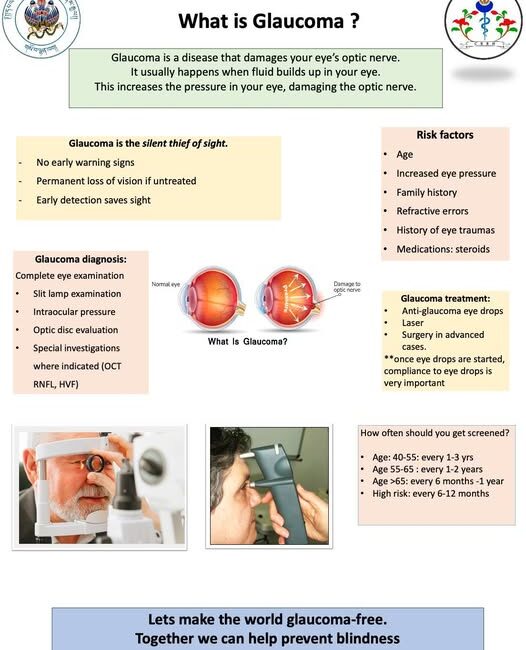
Glaucoma is a group of eye diseases that damages the optic nerve, mostly due to increased pressure inside the eyeball. If left untreated, this damage results in permanent and irreversible blindness. Globally, more than 80 million people are living with glaucoma, and over 111 million cases are expected by 2040.
Risk factors are:
1. Age above 60 years
2. Increased intraocular pressure
3. Prolonged use of certain medications, including steroids
4. Underlying medical conditions like diabetes
5. Family history of glaucoma, and
6. Refractive errors
Glaucoma is often called the “silent thief of sight” because it usually has no early warning signs. Many people are unaware they have glaucoma until they experience significant vision loss. So, screening for glaucoma is recommended as follows:
— 40-55 years old: Every 1 to 3 years
— 55-65 years old: Every 1 to 2 years
— >65 years old: Every 6 months to 1 year
— High Risk individuals: Every 6-12 months
Glaucoma can be detected with a comprehensive eye examination. Once diagnosed with glaucoma, the first line of treatment is anti-glaucoma eye drops to reduce the eye pressure. Once treatment is started, strict adherence to prescribed eye drops is essential, and requires lifelong use of eye drops, similar to medications for diabetes or hypertension, unless advised otherwise by an eye specialist. In selected cases, laser procedures may be performed, while surgeries may be required in more advanced stages.
Regular eye check-ups are the key to early detection to prevent vision loss from glaucoma. You can avail glaucoma check-up from Chamber # 1 (Ophthalmology Unit) in CRRH.
Let’s unite together for a glaucoma-free world.
𝐶𝑜𝑛𝑡𝑟𝑖𝑏𝑢𝑡𝑒𝑑 𝑏𝑦 𝐷𝑟 𝐶ℎ𝑒𝑛𝑐ℎ𝑜 𝐺𝑒𝑚, 𝑂𝑝ℎ𝑡ℎ𝑎𝑙𝑚𝑜𝑙𝑜𝑔𝑖𝑠𝑡